Indonesia’s industrial sector is hitting a generational tipping point. Data from Badan Pusat Statistik (BPS) confirms it: workers born between 1981 and 2010 now make up roughly 60% of the country’s labor force. In mining, manufacturing, and energy, the “old guard” is stepping back. The people now responsible for fire safety and first aid are digital natives.
These workers grew up with a smartphone in their hands and a gaming interface on their screens. Their brains are wired for interaction, not passive reception. Yet, most K3 (Occupational Health and Safety) programs in Indonesia still rely on a 1990s playbook: long lectures, static slides, and watching an instructor demonstrate a fire extinguisher while twenty people stand in a circle. This isn’t just boring; it’s a cognitive mismatch.
The Problem: A Neurological Mismatch
Research into digital-native learning (Prensky, 2001) is clear: these workers have a 10 to 15-minute window for passive content before their engagement hits zero. They don’t want to watch; they want to do.
A 25-year-old operator in a Cikarang factory processes information through pathways built by years of interactive media. When an HSE manager puts them in a 90-minute classroom session on “Fire Theory,” they aren’t being lazy when they check their phones. Their brain is simply signaling that the delivery method is obsolete. Conventional training requires information absorption through listening, while the digital native learns through spatial trial and error.
VGLANT’s Solution: Instructional Alignment
VGLANT (a member of VIRTU) doesn’t just “digitize” the manual. It changes the modality of learning to match the workforce’s reality. By using VR for fire safety and first aid, VGLANT activates the same cognitive and motor systems that these workers use in their daily digital lives.
1. Zero Latency Feedback
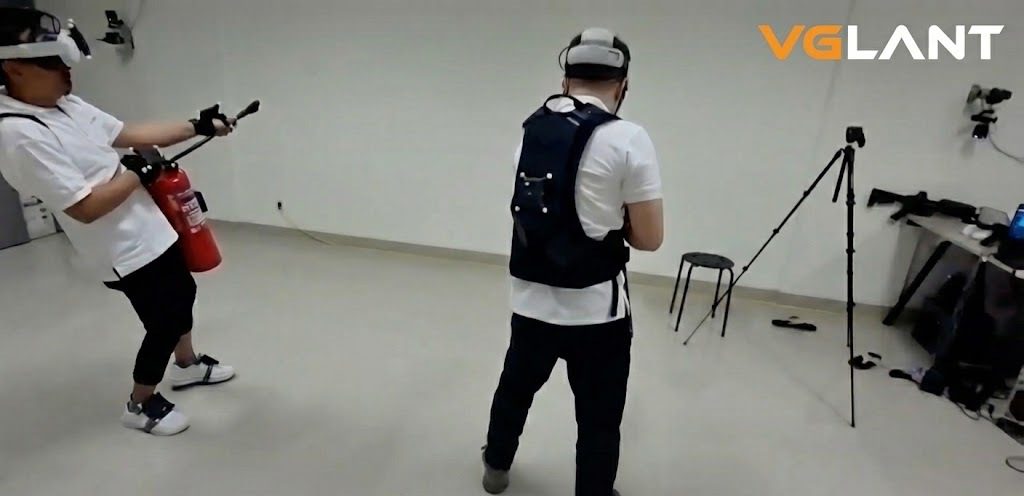
Digital natives expect immediate results. In a VGLANT scenario, if you aim the fire extinguisher (APAR) incorrectly, the fire doesn’t wait for a slide change—it spreads. If your CPR compressions are too shallow, the virtual patient’s vitals drop instantly. This cause-and-effect loop is exactly how this generation learns best. It’s intuitive, not artificial.
2. High-Frequency Participation
Every second in a VGLANT headset requires a decision. There is no “waiting for your turn” in a group of 20 people. Trainees are constantly scanning for hazards, selecting equipment via gesture, and executing movement. This active learning design ensures cognitive engagement remains at peak levels.
[Image: An Indonesian worker using the VGLANT VR All-in-One Pelican Case system in an industrial setting]
3. The End of Predictability
One reason conventional K3 training fails is that it’s repetitive. VGLANT utilizes randomized challenge variation. Every session can be different—a fire might break out in a different corner, or a casualty might have different injuries. This mirrors gaming design, maintaining a level of “novelty” that keeps the brain alert even after multiple sessions.
Retention and the Bottom Line
Training is only as good as what is remembered six months later. When modality matches preference, retention skyrockets. Digital-native workers encode procedural knowledge deeper in VR because their muscle memory is engaged, not just their hearing.
VGLANT’s Tracked Data Records provide the proof. Managers can see millisecond-level improvements in reaction times and accuracy across their specific workforce. It’s no longer a “gut feeling” that the team is ready; it’s a quantified fact on an administrator dashboard.
Employer Branding in a Competitive Market
In Indonesia’s mining and energy sectors, recruiting for remote sites is a battle. Deploying modern tools like VGLANT signals that a company is technologically advanced and invested in its people. For a Gen Z worker, a company using VR for safety training is a company that “gets it.” It differentiates the brand in a crowded recruitment landscape.
Conclusion
Indonesia’s industrial workforce has evolved, but safety training design has largely stayed anchored in the past. VGLANT closes this gap. By aligning instructional design with digital-native reality, VGLANT transforms safety from a passive requirement into a high-stakes, interactive skill. For any organization looking to move from “certified spectators” to “autonomous first responders,” the shift to VR isn’t just an upgrade—it’s a necessity.