Smart Mining 4.0 has become one of the more discussed concepts in Indonesian mining over the past five years. The term covers a wide span. IoT-enabled equipment. Integrated operational systems. Autonomous operations. Predictive analytics. Digital Twin platforms. VR-based training. Various combinations of all of these. Major operators have run pilots, made announcements, and in some cases moved into scaled deployment. Government policy through Kementerian ESDM has signaled support for digital transformation in extractive industries.
What’s still missing is a clear roadmap. Operators face questions about what to deploy, in what sequence, with what level of investment, and what realistic operational impact to expect. Vendor pitches push different priorities. Consultant frameworks vary. International benchmarks don’t always match Indonesian operational reality.
This article works through a practical roadmap for Smart Mining adoption in Indonesia — not an abstract framework, but the actual sequence that produces operational value given how Indonesian mining operations actually work and where they realistically sit in their digital maturity.

What Smart Mining 4.0 Actually Means
The term Industry 4.0 comes out of German manufacturing strategy. It refers to the integration of cyber-physical systems, IoT, cloud computing, and cognitive computing into industrial operations. Smart Mining 4.0 applies the same conceptual framework to mining — digitization, integration, and increasingly autonomous operation of mining processes through connected technology.
In practice, Smart Mining 4.0 covers several specific capability layers.
Connected equipment and sensor infrastructure. Heavy equipment instrumented with telematics. Environmental sensors monitoring atmospheric conditions. Geotechnical sensors tracking ground stability. Processing equipment with embedded condition monitoring. The foundation layer that makes everything else possible.
Data integration and analytics. Operational data from across the mining value chain — drilling, blasting, loading, hauling, processing, shipping — consolidated into platforms where it can be analyzed across functions rather than in isolated silos.
Digital Twin platforms. Spatial and operational representations of the mine, equipment, processes, and systems. These enable visualization, simulation, and predictive analysis across the four twin types discussed in previous pieces.
Predictive and prescriptive analytics. Machine learning and statistical modeling applied to operational data, supporting predictive maintenance, geological prediction, production optimization, and safety risk forecasting.
Autonomous and semi-autonomous operations. Equipment operating with reduced or eliminated direct human control. Autonomous haul trucks. Drill automation. Remote-controlled equipment in hazardous areas.
VR and AR for training and operational support. Immersive technology for operator training, safety scenario rehearsal, maintenance procedure guidance, and remote expert support.
Each capability produces operational value. They also build on each other. Skipping foundation layers to deploy advanced capabilities tends to produce expensive systems that don’t deliver the expected returns. The roadmap question is what order to deploy in — and how to match deployment pace to organizational and operational readiness.
Where Indonesian Mining Sits Today
A roadmap is only useful with a realistic starting point. Indonesian mining operations span a wide range of digital maturity. Several patterns appear consistently across the industry.
OEM telematics is widely deployed. Major equipment from Caterpillar, Komatsu, Hitachi, and Liebherr arrives with onboard monitoring systems — Cat Minestar, KOMTRAX, ConSite, Liebherr MTM. Most large Indonesian operations have access to this telemetry. The degree of integration with broader operational systems varies significantly.
Dispatch systems are mature in larger operations. Modular, Wenco, Caterpillar Mineware, and similar dispatch platforms run operations at most major Indonesian coal and metal mines. Fleet utilization, cycle time tracking, and basic operational analytics are established capabilities.
CMMS platforms are widely used but variably integrated. Maximo, SAP PM, Mincom Ellipse, Pulse, and similar maintenance management systems are deployed across the industry. The data they hold — maintenance history, component lifecycle, intervention records — is foundational for predictive maintenance. Integration with operational telemetry varies considerably.
Sensor coverage outside OEM equipment is uneven. Atmospheric monitoring, geotechnical sensors, environmental monitoring, and process sensors exist in varying density across operations. Underground operations generally have higher sensor density than surface operations, because the safety case for monitoring is stronger.
Data integration architectures are emerging but not universal. Many operations have data lakes, integration platforms, or operational data stores in development or recently deployed. Few have reached the level of integration where cross-functional analytics flow naturally from one system to another.
Digital Twin and VR are at pilot stage in most operations. Featured work like Virtu’s Smart Digital Twin Mining and Heavy Duty Mining Vehicles VR Training exists in deployed form at specific operations. Broader industry adoption is still building. Proof points exist; scaled adoption across the industry is still in progress.
Autonomous operations remain limited in Indonesia. Australia, Chile, and other major mining jurisdictions have moved significantly into autonomous haul trucks and other autonomous equipment. Indonesian operations have run pilots and announcements. Full autonomous deployment is still in early stages.
Skill availability for advanced applications is constrained. Indonesia produces a strong engineering workforce. Specialized capabilities — data scientists with mining domain expertise, automation engineers with extractive industry experience, Digital Twin developers with operational understanding — are in limited supply nationally. Most major operations face talent constraints in advanced digitalization.
This baseline is the realistic starting point. The roadmap below takes it as given, rather than assuming infrastructure or capability that isn’t actually present.
The Roadmap: A Five-Stage Progression
Smart Mining adoption produces better results when deployed in sequence rather than as parallel initiatives. The progression below reflects what works operationally, calibrated to Indonesian mining realities.
Stage 1: Foundation — Sensor and Data Infrastructure
The starting point for any Smart Mining program is having the data the rest depends on.
For most Indonesian operations, this means three things. Comprehensive integration of OEM telematics into a centralized data platform — not just OEM dealer dashboards. Sensor coverage extended to non-OEM areas — environmental monitoring, atmospheric monitoring in underground operations, geotechnical sensors in stability-critical zones, process sensors in handling and preparation circuits. Data integration architecture that pulls equipment, dispatch, CMMS, and operational data into common analytical layers.
Investment scale: significant capital expenditure on sensor infrastructure and integration platforms. Timeline: 12-24 months for foundational deployment, with ongoing enhancement.
Operational value at this stage: improved operational visibility, better basic analytics, foundation for everything that comes next. Value is real, but incremental compared to what later stages produce.
Common mistake: skipping or underinvesting in the foundation. Operations that try to deploy Digital Twin or predictive maintenance without solid sensor and data infrastructure end up with twins built on incomplete data. Result is unreliable.
Stage 2: Operational Analytics and Dashboards
Once data infrastructure exists, the next stage focuses on consolidated operational visibility.
This stage typically deploys Analytics Twin capability. Dashboard platforms that consolidate KPIs across production, maintenance, safety, environmental, and financial dimensions. Operations management gets unified views that previously required pulling reports from multiple systems. Trend analysis, comparative performance across sites, and basic anomaly detection become operational practices rather than ad-hoc exercises.
Investment scale: moderate. Most cost sits in integration and dashboard development rather than new infrastructure. Timeline: 6-12 months for initial deployment, with continuous refinement.
Operational value: significant improvement in management visibility, faster response to operational issues, better cross-functional decision-making. ROI typically materializes within the first year as operational decisions improve.
Common mistake: deploying dashboards without organizational change to consume them. Operations that build dashboards but continue making decisions through previous channels capture limited value.
Stage 3: VR-Based Training and Operator Development
The training and operator development layer typically deploys in parallel with analytics, rather than sequentially. Deployment requirements are different. Operational value is different. The two don’t depend on each other for foundational infrastructure.
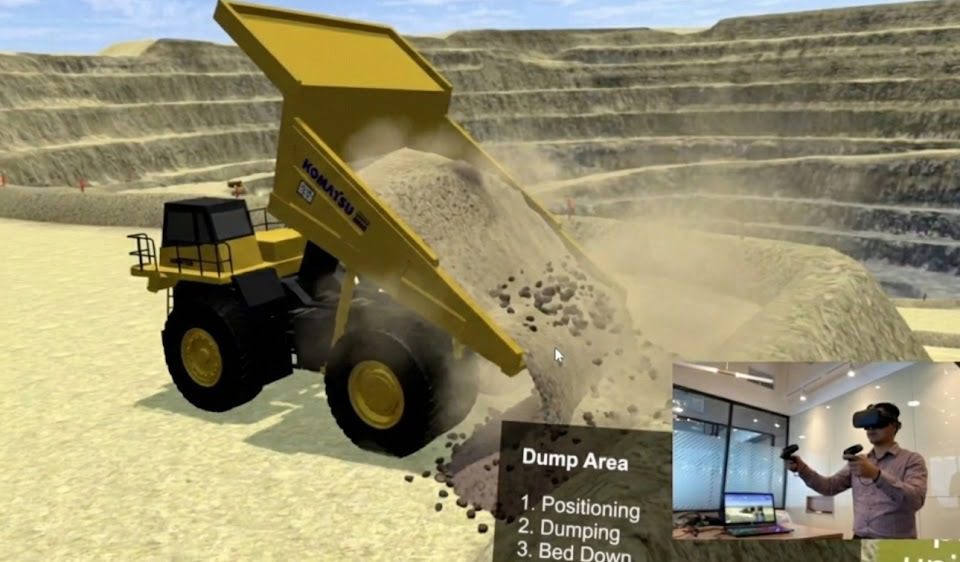
VR training applications include heavy equipment operator training (haul trucks, excavators, draglines), safety scenario training, working at height training, emergency response rehearsal, and underground mining-specific scenarios. Featured work like Heavy Duty Mining Vehicles VR Training demonstrates the operator-facing applications that produce direct operational value.
Investment scale: moderate. Hardware investment for headsets and motion platforms, plus content development for equipment-specific and site-specific scenarios. Timeline: 6-12 months for initial scope, with ongoing content expansion.
Operational value: reduced training time on production equipment, faster operator development, lower damage rates during early operator learning curves, broader scenario coverage than conventional training enables.
Common mistake: deploying generic VR training rather than equipment-specific and site-specific content. Training value scales with relevance to actual operational equipment and conditions.
Stage 4: Asset and Process Digital Twin
With data infrastructure mature and analytics in place, the next stage moves into Asset Twin and Process Twin deployments for specific high-value applications.
Common starting points: predictive maintenance for major equipment (haul truck fleets, excavator fleets, processing equipment), Process Twins for haul road optimization or processing flow analysis, and integration of these twins with the established analytics platforms. The previous discussion on the four digital twin types covers the technical structure of these deployments in detail.
Investment scale: significant — particularly for predictive maintenance applications that require deep sensor coverage and analytical infrastructure. Timeline: 12-18 months for production deployment of the first applications, with phased expansion.
Operational value: measurable reduction in unplanned downtime, improved equipment reliability, better process throughput, and foundation for more advanced applications. ROI is generally strong for predictive maintenance in operations with significant fleets.
Common mistake: trying to build comprehensive Asset Twins for every equipment class simultaneously. Successful programs focus on highest-value applications first and expand based on demonstrated results.
Stage 5: System Twin, Autonomous Operations, and Advanced Applications
The final stage of the roadmap addresses the most ambitious applications. Site-wide System Twin platforms. Autonomous and semi-autonomous operations. Advanced AI applications. Integration of all previous layers into unified operational platforms.
This is where the largest international mining operations have deployed in recent years. Indonesian operations sit at varying points in this transition. Some major operators are running advanced pilots. Others are still building toward this capability layer.
Investment scale: substantial. Cost runs into significant capital expenditure with multi-year timelines. Investment justification depends on operational scale and strategic importance. Timeline: 18-36 months for comprehensive deployment, with ongoing evolution.
Operational value: transformational at the operational level for operations that reach this stage with the foundational layers in place. Operations skipping foundational stages typically don’t capture this value, even with significant investment.
Common mistake: pursuing autonomous operations or System Twin deployment without the foundation in place. The most expensive failure mode in Smart Mining programs. It happens regularly when ambition outruns operational readiness.
How This Maps to Indonesian Regulatory and Policy Context
Indonesian government policy through Kementerian ESDM, BKPM, and related agencies has signaled support for digital transformation in extractive industries. Several specific policy elements affect Smart Mining roadmaps for Indonesian operators.
K3 Pertambangan compliance requirements increasingly emphasize digital documentation and predictive safety capabilities. Permen ESDM No. 26 Tahun 2018 and related regulations create operational obligations that Digital Twin platforms can support — through documented competency, incident analysis, and risk forecasting capabilities.
Environmental and ESG reporting requirements have grown more demanding. Operations face increasingly detailed obligations on environmental monitoring, emissions reporting, water management, and post-mining rehabilitation. Sensor infrastructure and data integration platforms — Stage 1 of the roadmap — provide the foundation for compliance, not just operational efficiency.
Local content requirements (TKDN) affect technology procurement decisions. Operations face expectations for local sourcing where feasible. Indonesian-developed Digital Twin and VR solutions can support TKDN scoring while providing the local engineering presence that sustained deployment requires.
Mining permit and ESDM reporting workflows are increasingly digital. Integration between operational platforms and government reporting systems is becoming a practical requirement — not just an efficiency consideration.
Government industrial policy around Industry 4.0 — most visibly through the Making Indonesia 4.0 initiative — provides supportive context for mining digitalization investment. Direct funding mechanisms are limited. Most investment remains operator-driven.
These policy factors don’t change the fundamental roadmap sequence. They do affect investment justification, vendor selection, and integration priorities at each stage.
What This Means for Different Operator Profiles
The roadmap above applies broadly. Different operator profiles approach it from different starting points and with different priorities.
Major coal contractors (BUMA, PAMA, Petrosea, and similar). These operations typically have mature Stage 1 and Stage 2 capabilities, with active Stage 3 and Stage 4 programs. The current frontier is moving Stage 4 from pilot to scaled deployment and beginning realistic Stage 5 evaluation. Investment scale is significant but justified by operational scale.
Major coal producers (Indo Tambangraya Megah, Adaro, Bumi Resources, and similar). Similar maturity profile to major contractors. An additional consideration: producer-operator relationships affect how digital infrastructure deploys across the value chain. Coordination between producers and contractors on data sharing, technology standards, and operational integration is part of the operational reality.
Mid-tier mining operations. Operations at smaller scale typically face different roadmap economics. Investment in Stage 1 sensor infrastructure carries proportionally similar cost but applies to smaller operations, which affects ROI timelines. Sequenced deployment focused on highest-value applications produces better outcomes than ambitious comprehensive programs.
Metal mining operations (gold, copper, nickel). Different operational profile than coal. Different equipment fleets, processing complexity, and regulatory considerations. The roadmap sequence applies. Specific applications at each stage differ. Underground mining operations face different priorities than open-pit operations — particularly around safety-critical applications.
State-owned enterprises (Pertamina subsidiaries, Antam, Bukit Asam, Timah, Inalum, and similar). State-owned operators face additional considerations including governance requirements, procurement processes, and policy alignment that affect technology deployment. The roadmap applies. Institutional context shapes pace and approach.
Each profile has specific circumstances. The fundamental roadmap sequence — foundation, analytics, training, twin deployment, advanced applications — applies broadly across all of them.
Practical Considerations for Operators Planning the Journey
Several factors affect successful Smart Mining program deployment in Indonesian contexts.
Organizational readiness matters as much as technical investment. Programs deployed without organizational change to consume the new capabilities tend to produce limited value, regardless of technical sophistication. Operations that invest in maintenance organization restructuring, operations team upskilling, and management practice evolution alongside technology deployment capture significantly more value than those treating digital transformation as a purely technical project.
Local engineering presence matters for sustained value. Smart Mining programs evolve. Equipment fleets change. Operating conditions shift. Programs supported by local engineering teams with ongoing presence adapt to operational changes. Programs dependent on remote international support tend to drift out of sync with operational reality.
Bahasa Indonesia integration matters operationally. Mining workforces in Indonesia are predominantly Indonesian-speaking. Platforms with Bahasa Indonesia interfaces, locally-supported deployment, and engineering teams accessible during operational hours integrate more cleanly than imported solutions with English-only interfaces.
Pilot scope matters for adoption. Programs that start small produce better adoption than ambitious comprehensive deployments. Successful pilots create the operational evidence and stakeholder buy-in that supports broader rollout. Unsuccessful ambitious programs often fail not for technical reasons. They fail because the organization couldn’t absorb the change at the scale attempted.
ROI measurement matters for sustained investment. Mining is a capital-intensive industry with disciplined investment evaluation processes. Programs that produce measurable operational impact — reduced downtime, lower maintenance cost, improved safety performance, faster operator development — sustain investment over time. Programs that produce strategic narrative without operational metrics tend to lose support.
Cross-functional governance matters. Smart Mining programs cross IT, operations, maintenance, safety, and corporate strategy boundaries. Programs governed through any single function struggle. Programs with cross-functional governance structures, including executive-level sponsorship, navigate the inevitable trade-offs more successfully.
These factors apply broadly across Indonesian mining operations. Each operation has specific circumstances. The structural considerations show up consistently across deployments.
Virtu is an Indonesian XR and Industry 4.0 company with a substantial portfolio in mining technology. The mining client base includes BUMA (Bukit Makmur Mandiri Utama), PAMA, Petrosea, United Tractors, and Indo Tambangraya Megah — covering major segments of the Indonesian mining sector.
Featured work covers multiple stages of the roadmap. Smart Digital Twin Mining for coal mine operations addresses Stage 4 Asset and Process Twin applications. Heavy Duty Mining Vehicles VR Training addresses Stage 3 operator development. Working at Height VR Training and other safety-focused modules address training applications across operational scenarios. The portfolio reflects Virtu’s positioning as an Indonesian provider supporting domestic mining digitalization across multiple capability layers.
Virtu’s process for Smart Mining engagements follows four stages: Diagnose (understanding the operational requirement and matching capability scope to the operation’s actual stage in the roadmap), Design (architecting the implementation approach and integration with existing operational systems), Develop (building the platform and integrating with telematics, dispatch, CMMS, and operational data sources), and Deploy (installation, testing, organizational handover, and ongoing operational support).
The company is Indonesian-based, with engineering and project delivery capacity in-country. This matters for Smart Mining work that requires sustained collaboration with site operations, IT teams, maintenance organizations, and operational stakeholders across the multi-year timelines that comprehensive Smart Mining programs require. Voice prompts and UI default to Bahasa Indonesia, with English available for multinational operations. Implementation work spans the roadmap stages — scoped to where the operation actually is, rather than where vendor pitches assume.
For roadmap conversations, capability briefings, or pilot deployments at any stage of Smart Mining adoption, Virtu can be reached through the contact form at https://virtu.co.id/ or via WhatsApp at +62 812 9696 7887.