In the mining sector, silence is a financial disaster. When a primary haul truck stalls or a conveyor belt snaps, it doesn’t just stop one machine—it triggers a domino effect that chokes the entire supply chain. These unplanned outages are the single biggest drain on revenue and the primary cause of inflated operational budgets.
Traditionally, maintenance was a game of “best guesses” based on rigid, time-based schedules (e.g., swapping a component every 500 hours regardless of its actual wear). Today, the Digital Twin is moving the industry into the era of Predictive Maintenance & Planning. It turns unpredictable mechanical failures into manageable, scheduled events.
Mirroring Behavior: The Digital Pulse of Your Fleet
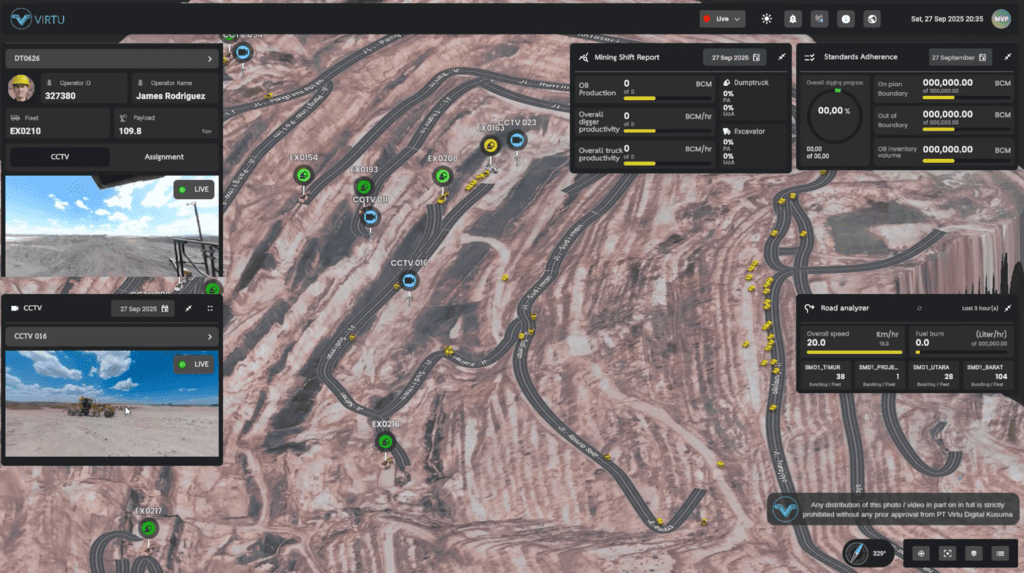
A Digital Twin does more than track a GPS coordinate; it understands the “biological” health of a machine. By mirroring the behavior of physical assets through high-frequency sensor data, the digital replica functions as a 24/7 diagnostic tool.
VIRTU’s platform fuses multiple data streams—engine thermals, vibration harmonics, fluid pressures, and fuel burn—to create a “digital pulse” for every unit. When a machine deviates from its normal operating signature, the Digital Twin identifies these “symptoms” weeks before a human operator would notice a change.
- Vibration Analysis: Identifying early-stage bearing failure in crushers before they seize.
- Thermal Monitoring: Flagging overheating components before they result in an engine fire.
- Hydraulic Tracking: Catching pressure drops that signal a slow leak or pump degradation.
Shifting to Condition-Based Maintenance (CBM)
The real ROI of a Digital Twin is the pivot from time-based maintenance to Condition-Based Maintenance (CBM). You no longer pull a machine out of the pit just because a calendar says so. Instead, engineers execute repairs only when the telemetry dictates it.
This strategy delivers three specific tactical advantages:
- Extended Asset Lifecycle: Components are used to their actual potential, killing the waste of “early” replacements.
- Strategic Scheduling: Repairs are front-loaded during natural production lulls or shift changes. This keeps the “Active Fleet” at 100% capacity during high-target hours.
- Inventory Optimization: Knowing exactly what will fail and when allows for “Just-in-Time” spare parts procurement. This frees up capital that would otherwise be tied up in stagnant warehouse stock.
The 50% Reduction: Data as a Revenue Stream
The numbers are hard to ignore. Industrial data shows that firms implementing Digital Twin-driven maintenance see up to a 50% reduction in unplanned outages.
By turning historical wear-and-tear data into a roadmap for future performance, VIRTU ensures your fleet stays mobile. In an industry where seconds dictate the bottom line, the ability to “predict the unpredictable” isn’t just a tech upgrade—it’s the difference between a profitable quarter and an operational write-off.
Conclusion: From Repair Crew to Productivity Team
With VIRTU, your maintenance team stops being a reactive “repair crew” and becomes a proactive “productivity team.” You are no longer fixing things that broke; you are securing the heartbeat of the mine. In the coal and mineral sectors, the only thing more expensive than a Digital Twin is the cost of the silence when your fleet stops moving.